Choosing pavers or concrete for your outdoor space
Pavers and poured concrete handle movement differently, and neither replaces a drainage plan. We explain what to look for before you choose a surface for your South Florida patio or driveway.
 PSR Home Remodeling · · 5 min read

Start with how you use the space
A patio outside your sliding glass doors and a driveway carrying vehicles have different demands. Before choosing pavers or poured concrete, we look at traffic, existing ground conditions, nearby trees and where rainwater goes. The surface has to work with the house, not just match its color.
Interlocking concrete pavers are separate units installed together. Poured concrete forms a continuous slab divided by planned joints. That difference affects how movement appears and what a repair involves. Both need suitable support beneath them, and neither makes an unstable or poorly drained site acceptable.
For a driveway, tell us what vehicles use it and whether anyone parks along the edges. For a patio, consider furniture, walking routes and the transition through the door. These decisions shape the installation before you choose a pattern or finish.
How each handles ground movement
In South Florida, sandy ground, disturbed fill, tree roots and water moving beneath a surface can affect its support. We often see the result at driveway edges and beside patios: a low area, a raised edge or water collecting where it did not collect before.
Pavers can accommodate minor movement through their joints without developing a continuous crack across the paved area. That flexibility has limits. Loss of support can leave units tilted, sunken or separated. A surface that moves underfoot needs attention even when the individual pavers remain intact.
A concrete slab behaves differently. Concrete shrinks as it dries, and changes in support or temperature can create stress. Planned contraction joints encourage shrinkage cracking along selected lines. They do not prevent every crack, and reinforcement does not eliminate cracking.
Choose the repair approach you are comfortable living with. Pavers allow a disturbed area to be lifted and reset. With concrete, correcting substantial movement may require removing and replacing an affected section. Either way, the cause beneath the surface matters more than hiding the symptom.
Our article on what is under a paver patio explains the supporting layers. Here, the practical distinction is how each finished surface responds when that support changes.
What a crack means and how repairs differ
A narrow concrete crack with level edges is different from a crack with a raised side, widening separation or nearby settlement. Appearance alone does not establish the cause. We look at the surrounding surface, drainage and whether the condition is changing before discussing repair.
A crack repair can remain visible. Filling an opening does not necessarily restore support beneath the slab or stop movement. Where replacement is appropriate, the new concrete may differ in color and texture from the surrounding surface. Decide whether a visible repair is acceptable before choosing a highly uniform finish.
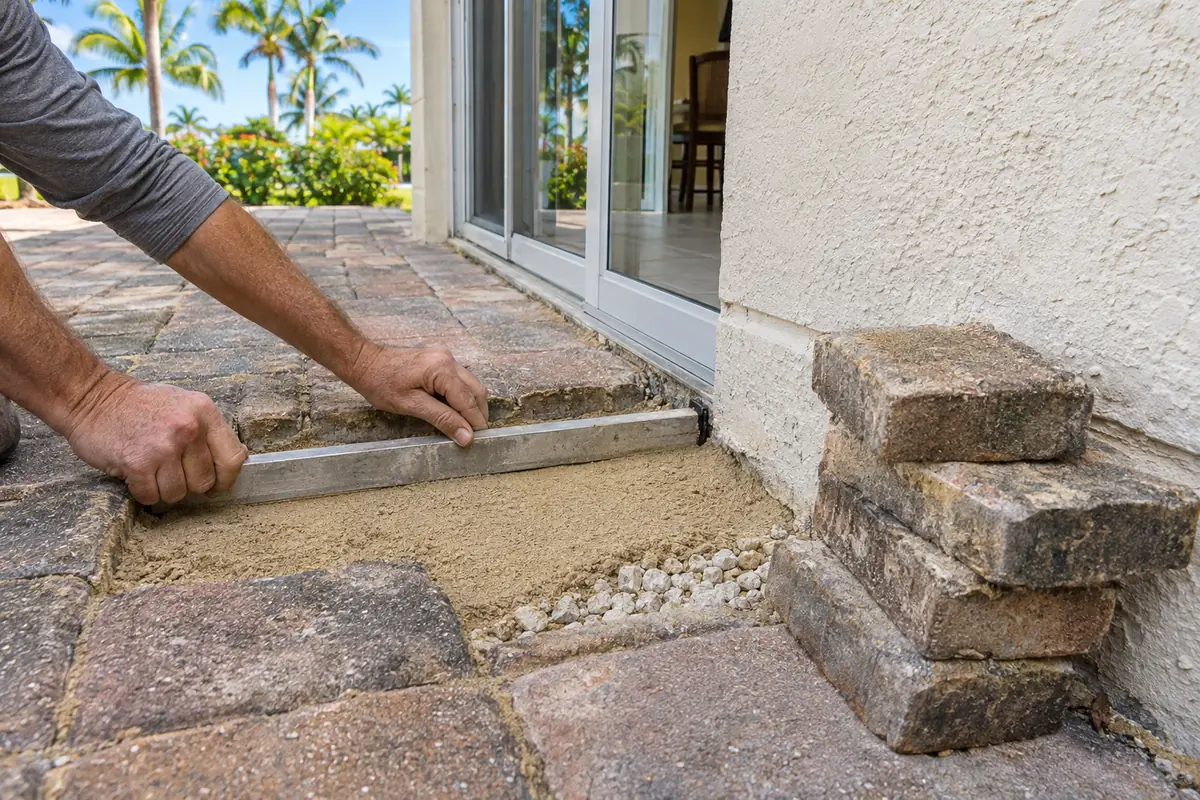
A cracked paver can often be replaced individually. If several units have settled, the repair may involve lifting them, correcting the support and reinstalling them. Simply adding material beneath a low spot without addressing water loss or movement can leave the underlying problem unresolved.
Keep spare matching pavers if you choose that surface. Replacement units may not match weathered material exactly. Also remember that a repaired patch needs its joints and edges restored, not just its top surface made level.
Plan the water route before the finish
Summer downpours test the layout of a patio or driveway. We trace water from roof discharge and surrounding ground toward an appropriate outlet. At block walls, painted stucco and sliding door tracks, finished elevations need particular attention. Raising a surface without checking these connections can create a new water problem.
Standard pavers are not automatically a permeable pavement. Their joints do not mean you can ignore surface drainage. A permeable installation is a different system designed to accept and manage water through its joints and supporting layers. Whether it suits your property depends on site conditions and local requirements.
Poured concrete also needs deliberate slope and drainage connections. A drain is only useful if the collected water has somewhere appropriate to go. We do not treat sending runoff toward a neighbor or an entry door as a solution.
- Show us where puddles form after rain.
- Point out downspouts, irrigation runoff and areas that stay damp.
- Identify door thresholds, garage entries and existing drains.
- Check with your building department before changing drainage or driveway access, and ask your association about exterior requirements.
Photos taken after a downpour can help explain what a dry site visit cannot show. Surface choice comes after understanding that water route.
Where stamped concrete fits
Plain concrete offers a broad, relatively quiet surface, though its planned joints remain part of the appearance. Pavers create a visible pattern of individual units and joints. Borders and changes in laying direction can define a seating area or driveway edge without changing materials.
Stamped concrete is poured concrete with a pattern pressed into the surface, sometimes with added color. It can suggest stone or individual paving units, but those impressions are not separate pieces. The slab still needs planned joints, and it still behaves like concrete when it cracks or loses support.
That distinction matters during repairs. Matching a stamped pattern, color and weathered finish can be difficult. A crack can cross the decorative pattern rather than follow its apparent joints. Choose stamped concrete because you like its appearance, with a clear understanding of that repair limitation.
Ask about traction when wet, cleaning and any proposed sealer. Texture alone does not establish how a finished surface feels under wet shoes. Humidity, shaded areas, salt air and leaves are reasons to discuss care for either material, not reasons to expect a surface that never needs attention.
Make the choice around your priorities
If localized repair access and a jointed pattern matter to you, pavers are worth considering. If you prefer a continuous appearance and accept that future repairs may show, poured concrete may fit. Stamped concrete belongs in the conversation when its decorative finish matters enough to accept more involved visual matching.
We install pavers and hardscaping and remodel patios and decks across Miami-Dade, Broward and Palm Beach counties. Our hardscaping and concrete pavers page is a useful starting point for discussing the surface, drainage and surrounding work together.
Request a free in-home estimate or call (866) 826-5523 to compare options for your patio or driveway.
Written by PSR Home RemodelingLicensed and insured remodeling contractor serving Broward, Miami-Dade and Palm Beach counties. 804 NW 21st Terrace, Miami.


